
The Critical Role of SRD Rotors
- mtekcorp
- May 1
- 2 min read
Updated: Aug 5
In semiconductor manufacturing, the Spin Rinse Dryer (SRD) is a workhorse that relies on mechanical precision to ensure yield. Because these systems operate at high rotational speeds, the Rotor is the most critical component for maintaining balance and preventing wafer breakage.

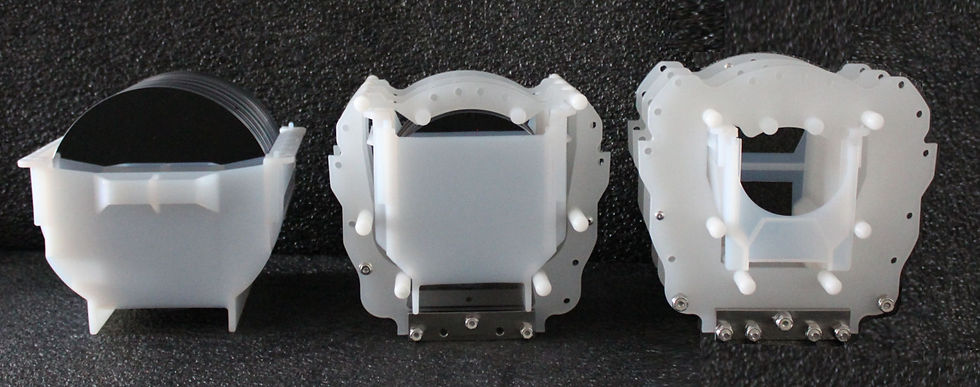
M Tek Quick Disconnect Rotor 
Cassette with wafers in QD Rotor
The Role of the Rotor in SRD Operations:
The rotor serves as the mechanical interface between the motor and the wafer load. Its primary functions include:
Secure Containment: Holding the cassette (wafer carrier) firmly against high centrifugal forces.
Spinning: Generating centrifugal force to shed liquid from the wafer surfaces.
Drying: Creating airflow patterns that, combined with heated Nitrogen, ensure no "water spots" or ionic contaminants remain.
Balancing: When properly balanced and installed - Minimizing "run-out" or wobble, which can cause micro-cracks in fragile silicon wafers.
Engineering and Balancing Requirements:
Each M Tek Rotor is custom-engineered for a specific wafer size, substrate or custom media (i.e.,100mm 150mm, 200mm, 300mm) and cassette type. If you have not already chosen the cassette for your project, we can assist you.
The engineering focus typically revolves around three factors:
Material Integrity: M Tek SRD Rotors are constructed from high-grade stainless steel (304 and 316L)
Dynamic Balancing: A rotor must be dynamically balanced. Improperly balanced rotors can lead to harmonic vibrations at high RPMs, potentially resulting particle contamination from the cassette moving inside the rotor.
Contamination Control: Our advanced designs eliminate "dead zones" or pockets where moisture could be trapped.
Process Consistency
A well-maintained and precisely designed Rotor ensures:
Optimized Drying: Consistent N2 flow patterns which reduce the chance of moisture retention on wafers.
Low MTBF (Mean Time Between Failure): Reduced vibration extends the life of the motor bearings and seals.
Particle Reduction: Smooth rotation prevents the physical contact or friction that creates sub-micron particulates.
Insight Tip: When switching cassette brands or wafer thicknesses, it is vital to verify if the existing rotor is rated for the new configuration. A change in the center of gravity of the load can necessitate a re-balancing of the rotor assembly to maintain process specs.
Comments